You’ve Never Tasted Ethiopia Like This – Lalibela’s Hidden Food Soul
Most people visit Lalibela for its rock-hewn churches, but I went for something deeper—its food. What I found was a world of flavors no guidebook prepared me for: spicy stews simmered for hours, injera with a soul, and coffee ceremonies that feel like time standing still. This isn’t just eating—it’s storytelling through taste. If you think you know Ethiopian cuisine, think again. Lalibela’s culinary culture is quiet, sacred, and wildly underrated. Let me take you where the real feasts begin.
Beyond the Stones: Discovering Lalibela’s Living Food Culture
Lalibela is renowned for its 12th-century monolithic churches carved directly from volcanic rock, attracting pilgrims and tourists alike who come to witness architectural wonders that seem to rise from the earth itself. Yet beneath the shadow of these sacred structures lies another, less visible heritage—one of fire-lit kitchens, simmering pots, and generations-old recipes passed from mother to daughter. While guidebooks focus on the spiritual significance of the churches, few highlight the equal reverence with which food is treated in this highland town. Here, cuisine is not a side note to culture; it is culture itself, woven into the rhythms of faith, family, and farming.
In Lalibela, meals are not scheduled around convenience but around tradition. The daily rhythm follows the sun, the seasons, and the liturgical calendar of the Ethiopian Orthodox Church. Breakfast might be a simple serving of leftover injera dipped in spiced honey or yogurt, eaten quietly before dawn prayer. Lunch, often the largest meal, unfolds slowly, shared among extended family under the shade of a eucalyptus tree. Dinner is lighter, sometimes just a warm cup of spiced milk or a small portion of stew, depending on the day’s observances. Unlike the bustling restaurants of Addis Ababa, where fusion dishes and modern plating styles cater to international tastes, Lalibela’s food remains untouched by culinary tourism. It is preserved in homes, cooked with intention, and served with a humility that speaks volumes.
What makes Lalibela’s food culture truly distinct is its integration with daily life. There are no celebrity chefs or Michelin aspirations here—only grandmothers stirring pots with wooden spoons, children grinding spices on flat stones, and farmers bringing freshly harvested vegetables from their terraced fields. Every ingredient carries a story: the teff grown on sun-drenched slopes, the lentils dried in woven baskets, the coffee beans picked by hand from small family plots. This is food as memory, as identity, as devotion. To taste it is to step into a world where nourishment extends far beyond the physical, where every bite reflects centuries of resilience, faith, and community.
The Rhythm of Fasting and Feasting: How Religion Shapes the Plate
In Lalibela, the calendar does not revolve around months or holidays alone—it turns on cycles of fasting and feasting dictated by the Ethiopian Orthodox Church. Over 60% of the population observes fasting rules that prohibit the consumption of animal products, including meat, dairy, and eggs, for more than 200 days each year. These include weekly fasts on Wednesdays and Fridays, extended periods like Lent, and various other religious observances. Far from being a limitation, this practice has given rise to one of the most sophisticated plant-based cuisines in the world—a cuisine where vegetables, legumes, and grains are not afterthoughts but the stars of the table.
On fasting days, the kitchen becomes a laboratory of flavor and texture. Dishes like shiro wat, a velvety stew made from ground chickpeas or lentils, are simmered slowly with onions, garlic, and berbere spice until they achieve a deep, smoky richness. Misir wat, a fiery red lentil stew, is another staple, its heat balanced by the sourness of injera. Even greens like collards and cabbage are transformed—slow-cooked with turmeric, ginger, and mustard seeds into dishes known as gomen and silsi, their flavors layered and complex. These are not simple substitutions for meat; they are complete culinary expressions in their own right, each carrying the weight of tradition and the ingenuity of generations who learned to create abundance from restraint.
When feast days arrive—such as Timkat (Epiphany) or Meskel (Finding of the True Cross)—the tables shift dramatically. The fast breaks with the aroma of roasting lamb, spiced butter sizzling in clay pots, and rich stews like doro wat, a chicken stew slow-cooked with hard-boiled eggs and seasoned with intense berbere. These meals are communal events, often prepared in large quantities and shared with neighbors, relatives, and even strangers. The contrast between fasting and feasting is not just dietary—it is emotional, spiritual, and social. It teaches patience, gratitude, and the joy of celebration after discipline. For visitors, understanding this rhythm offers a deeper appreciation of the food: it is not merely consumed but experienced as part of a living spiritual practice.
Injera with a Story: From Teff Farm to Fermented Magic
No meal in Lalibela is complete without injera, the spongy, sourdough flatbread that serves as both plate and utensil. But in this highland town, injera is far more than a staple—it is a symbol of continuity, care, and craft. Unlike the factory-made versions found in urban centers, Lalibela’s injera is made entirely by hand, using methods unchanged for generations. The process begins in the fields, where farmers harvest teff, a tiny, iron-rich grain native to the Ethiopian highlands. Grown at elevations over 8,000 feet, teff thrives in the cool, dry climate of the region, its delicate seeds carefully collected and stored in woven granaries.
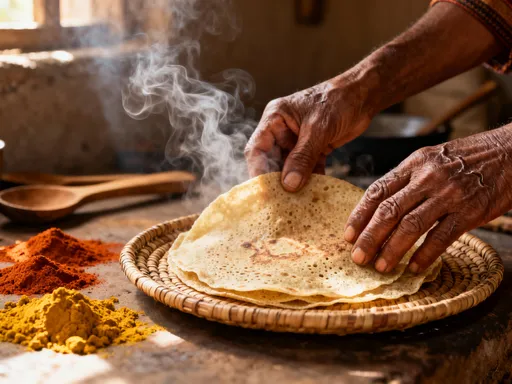
Back in the home kitchen, the transformation begins. The teff is stone-ground into a fine flour, a labor-intensive process that preserves the grain’s nutrients and flavor. The flour is mixed with water and left to ferment for two to three days, a crucial step that develops the bread’s signature tang. The batter is then poured onto a large, circular clay griddle called a mitad, heated over an open fire fueled by dried dung or eucalyptus branches. With a swift, circular motion, the cook spreads the batter thin, allowing it to bubble and cook into a large, lacy pancake. The smell—earthy, slightly acidic, deeply comforting—fills the courtyard and draws family members from every corner of the house.
Each household’s injera carries subtle differences—some more sour, others softer or thicker—reflecting variations in fermentation time, water source, and personal preference. This is not mass production; it is culinary artistry shaped by environment and heritage. Injera is more than food; it is a living archive. It carries the taste of the soil, the rhythm of the seasons, and the hands that prepared it. To eat from a shared platter, tearing off pieces of injera to scoop up stew, is to participate in a tradition of unity and humility. It is a reminder that in Lalibela, even the simplest bread is made with intention and reverence.
Hidden Kitchens: Eating Where Locals Eat
In Lalibela, the most authentic meals do not happen in restaurants with laminated menus or English-speaking waitstaff. They unfold in courtyards shaded by acacia trees, in low-ceilinged kitchens filled with woodsmoke, and in family homes where visitors are welcomed not as customers but as guests. These are not staged performances for tourists; they are genuine expressions of hospitality, rooted in the Ethiopian value of gursha—the act of feeding another by hand as a gesture of trust and affection. To be invited into one of these homes is to receive a rare and precious gift.
With the help of a local guide who grew up in the town, I was welcomed into the home of a woman named Aster, a mother of five and a cook whose recipes have been passed down for generations. Her kitchen was simple: a clay oven, a few metal pots, and a wooden table where she kneaded injera batter each morning. That day, she prepared a full platter—doro wat with tender chicken and hard-boiled eggs, misir wat with lentils simmered in berbere, gomen with collard greens, and fresh ayibe, a mild cheese served on the side. We sat together on low stools around a mesob, the traditional woven basket that serves as a table, and ate with our right hands, dipping pieces of injera into each dish.
What struck me most was not the richness of the food, but the warmth of the moment. There were no cameras, no performances—just laughter, stories, and the quiet pride of sharing one’s culture. Aster explained that she rarely cooks for outsiders unless she feels a real connection. “Food is personal,” she said. “It’s not something you sell. It’s something you give.” This sentiment is common in Lalibela, where trust is built slowly and hospitality is earned. For travelers, the key to accessing these experiences lies not in money, but in respect—asking permission, showing gratitude, and being willing to listen more than speak.
The Coffee Ceremony: More Than a Drink, It’s a Ritual
In much of the world, coffee is a commodity, a quick boost to start the day. In Lalibela, it is a sacred ritual—a 90-minute ceremony that engages all the senses and strengthens social bonds. Known as the buna ceremony, it is typically led by a woman who roasts green coffee beans over a small charcoal stove, shaking them in a long-handled pan until they pop and release a rich, smoky aroma. Frankincense or myrrh is often burned alongside, filling the air with a scent that feels both ancient and intimate.
The roasted beans are then ground by hand using a wooden mortar and pestle, a rhythmic pounding that signals the beginning of the gathering. Hot water is poured over the grounds in a traditional clay pot called a jebena, and the coffee is brewed slowly, allowing the flavors to deepen. It is served in small porcelain cups, poured from a height to aerate the liquid, and offered in three rounds: abol, tona, and baraka. The first round is said to honor the divine, the second to bless the guests, and the third to bring closure and blessings for the future. Each round is accompanied by conversation, storytelling, and moments of quiet reflection.
The coffee ceremony is not about caffeine—it is about presence. It slows time, invites connection, and creates space for what truly matters: family, faith, and friendship. In a world that values speed and efficiency, this ritual stands as a quiet act of resistance. For visitors, being invited to a buna ceremony is a profound honor, a sign of acceptance into the community. It is not something to be rushed or observed from a distance; it is meant to be lived, one cup at a time.
Spices, Scents, and Secrets: The Flavor Palette of the Highlands
The soul of Lalibela’s cuisine lies in its spices—complex, aromatic, and deeply tied to the land. The most iconic blend is berbere, a fiery mixture of dried chilies, garlic, fenugreek, paprika, cardamom, cloves, and rue, a bitter herb native to the highlands. Unlike commercial versions, which often lack depth, Lalibela’s berbere is made fresh in small batches, ground by hand on stone slabs, and adjusted seasonally to match available ingredients. The result is a spice blend that is not just hot, but layered—smoky, slightly sweet, and profoundly aromatic.
In the local market, women sit beside colorful mounds of spices, blending them with precision and pride. They know exactly how much chili to add for balance, when to include a pinch of salt, and which herbs will enhance a stew’s complexity. Another essential ingredient is mitmita, a hotter, citrusy spice blend often used with raw meat dishes or as a table condiment. Even more fundamental is niter kibbeh, spiced clarified butter infused with garlic, ginger, turmeric, and holy basil. Though avoided on fasting days, it is essential for feast-day cooking, adding richness and depth to stews and breads.
The high altitude of Lalibela—over 8,200 feet above sea level—also plays a crucial role in flavor development. The cooler temperatures slow the cooking process, allowing stews to simmer for hours without burning, and enabling flavors to meld gradually. This environment also affects fermentation, giving injera its distinctive tang, and influences the growth of herbs and vegetables, making them more concentrated in taste. Every element of the landscape contributes to the plate, creating a cuisine that is inseparable from its geography. To taste Lalibela’s food is to taste the highlands themselves—wind-swept, resilient, and deeply alive.
How to Experience Lalibela’s Food Culture Respectfully
To truly experience the food of Lalibela, travelers must shift their mindset from observation to participation. This is not a culture that opens its doors to those who treat it as a spectacle. Respect is the first ingredient. Simple gestures—dressing modestly, removing shoes before entering a home, using the right hand for eating—go a long way in building trust. Learning a few basic phrases in Amharic, such as “Tezafen?” (May I eat?) or “Ameseginalehu” (Thank you), shows genuine interest and appreciation.
Timing matters. Travelers should be aware of fasting days, when many households and local eateries serve only vegan dishes. Rather than seeing this as a limitation, it is an opportunity to experience the depth and variety of Ethiopia’s plant-based cuisine. Asking questions with humility—about ingredients, preparation methods, or traditions—can lead to meaningful conversations and, sometimes, invitations to share a meal. But it is important to listen more than speak, to accept silence as part of the rhythm, and to avoid treating every interaction as a transaction.
The best meals in Lalibela are not found on menus. They come from relationships—through a guide who introduces you to their cousin, a priest who invites you to his home, or a market vendor who remembers your face. These moments cannot be rushed or forced. They require patience, openness, and a willingness to be a guest rather than a consumer. When approached with sincerity, the people of Lalibela often respond with generosity that feels boundless. In return, visitors gain not just a meal, but a memory that lingers long after the journey ends.
A Feast for the Soul
Lalibela’s food culture is a quiet masterpiece—one that doesn’t shout for attention but reveals itself slowly, like the carvings in its ancient churches. It is not designed for Instagram or viral fame. It exists in the hands of women who stir pots at dawn, in the laughter shared over a shared mesob, in the incense that rises during a coffee ceremony. To taste this cuisine is to understand resilience, faith, and community in their most authentic forms.
In a world of fast travel and faster food, Lalibela offers a different kind of journey—one measured not in miles, but in moments of connection. It reminds us that the deepest experiences are not found in sightseeing, but in sitting down with others, breaking bread, and listening. The flavors here are not just of berbere and teff, but of time, tradition, and trust. For the traveler willing to slow down, to show respect, and to open their heart, Lalibela offers more than a meal. It offers belonging. Let your next adventure begin not with a map, but with a plate.